by Zelkulon05 March 20251 min read
Structure, connect and secure microservices with Spring Boot – a complete practical guide with real code examples and architecture diagrams.
What are Microservices?
A microservice architecture splits an application into small, independently deployable services. Each service is responsible for exactly one business domain – the Bounded Context from Domain-Driven Design.
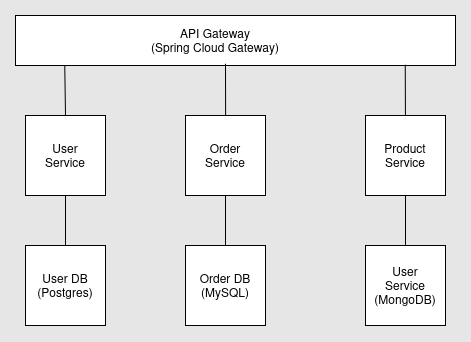
Each service has its own database – this prevents tight coupling and allows each service to choose its own database type.
Project Structure
order-service/
├── src/main/java/com/zelkulon/order/
│   ├── OrderServiceApplication.java
│   ├── controller/
│   │   └── OrderController.java
│   ├── service/
│   │   ├── OrderService.java
│   │   └── OrderServiceImpl.java
│   ├── repository/
│   │   └── OrderRepository.java
│   ├── model/
│   │   ├── Order.java
│   │   └── OrderItem.java
│   └── dto/
│       ├── OrderRequest.java
│       └── OrderResponse.java
└── src/main/resources/
    └── application.yml
The Domain Model
@Entity
@Table(name = "orders")
public class Order {

    @Id
    @GeneratedValue(strategy = GenerationType.UUID)
    private String id;

    private String customerId;

    @Enumerated(EnumType.STRING)
    private OrderStatus status;

    @OneToMany(cascade = CascadeType.ALL, fetch = FetchType.LAZY)
    private List<OrderItem> items = new ArrayList<>();

    private BigDecimal totalAmount;

    @PrePersist
    void onCreate() {
        this.createdAt = LocalDateTime.now();
        this.status    = OrderStatus.PENDING;
    }
}
Service-to-Service Communication with Feign
With Spring Cloud OpenFeign, another microservice behaves like a local service object:
@FeignClient(name = "product-service", url = "${services.product.url}")
public interface ProductServiceClient {

    @GetMapping("/api/products/{productId}")
    ProductDto getProduct(@PathVariable String productId);

    @PutMapping("/api/products/{productId}/stock")
    void reduceStock(@PathVariable String productId,
                     @RequestParam int quantity);
}
Circuit Breaker with Resilience4j
Circuit Breakers prevent cascading failures when a service is unreachable:
@Service
public class OrderServiceImpl implements OrderService {

    @Override
    public OrderResponse placeOrder(OrderRequest request) {
        CircuitBreaker cb = circuitBreakerFactory.create("product-service");

        boolean available = cb.run(
            () -> checkProductAvailability(request.getItems()),
            throwable -> {
                log.warn("ProductService unreachable – fallback active");
                return false;
            }
        );

        if (!available) throw new OrderException("Products unavailable");
        return processOrder(request);
    }
}
Saga Pattern for Distributed Transactions
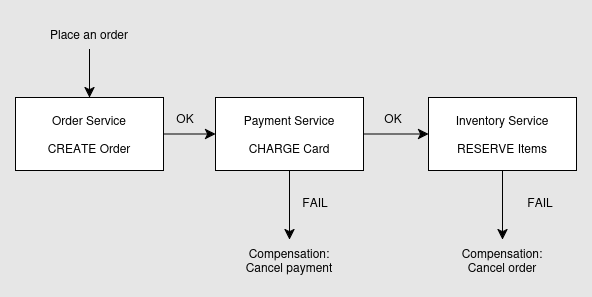
In microservices there are no global database transactions. The Saga Pattern solves this problem:
Summary
- One service = one business domain – no god services
- Own database per service prevents data coupling
- Circuit Breakers are mandatory for production-ready systems
- API Gateway centralizes authentication and routing
- Saga Pattern solves the problem of distributed transactions