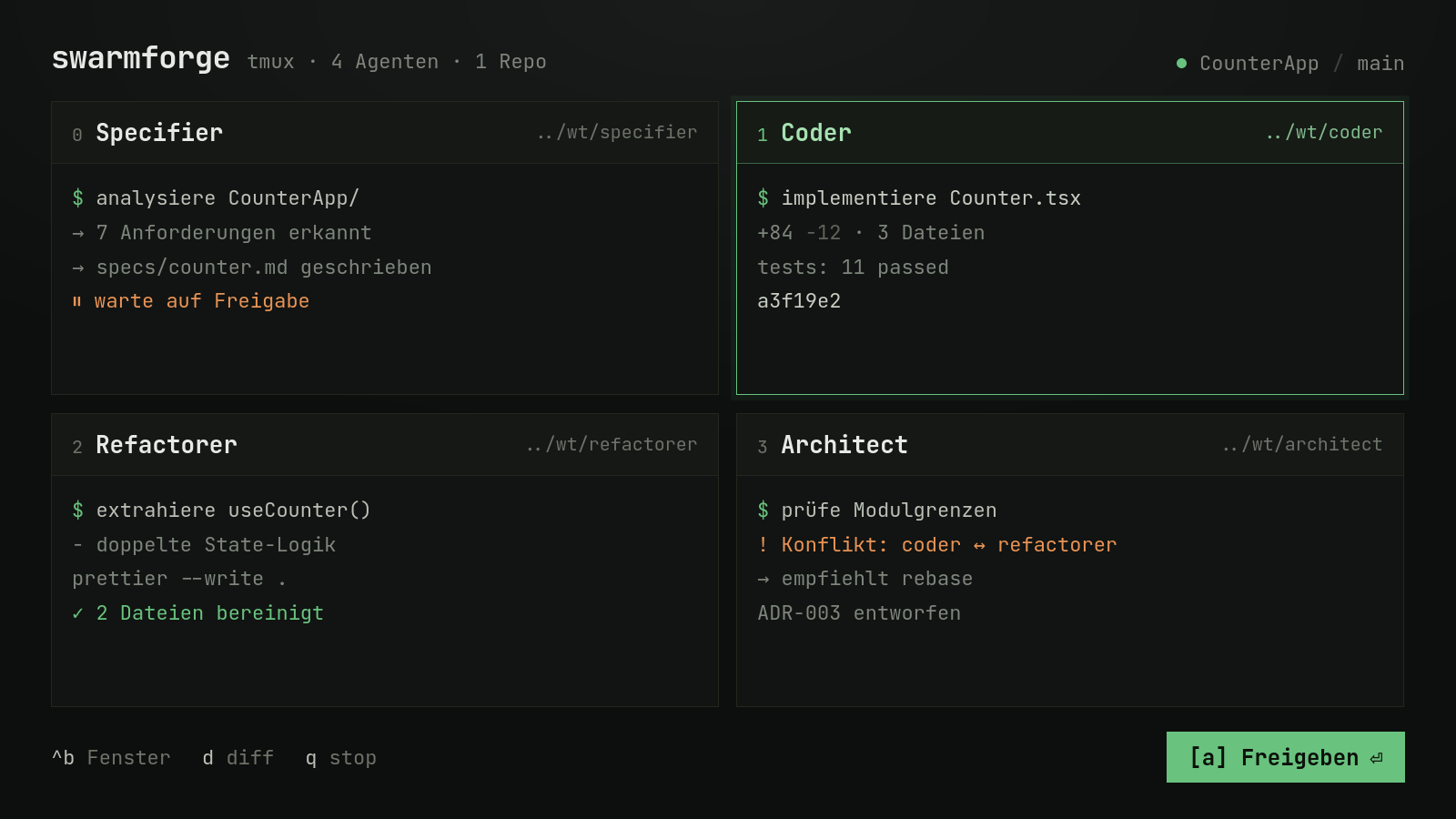
Uncle Bob's tmux tool lets four Claude agents work on your code in separate Git worktrees – Specifier, Coder, Refactorer, Architect, each in its own window with an approval button. I tested it on CounterApp and learned more about Git worktrees than I wanted to. Verdict up front: disciplined, but not plug and play.
Four windows, one dashboard
I'm sitting in front of four tmux windows, watching four AI agents hand work back and forth to each other. In the browser next to them, a dashboard with columns for Specifier, Coder, Refactorer, Architect and Done. I click “Approve”, and somewhere an agent starts specifying a pause function that wasn't even an idea in my head an hour ago.
That's SwarmForge in practice: Robert C. Martin's – yes, Uncle Bob, Clean-Code Uncle Bob – tmux-based tool that lets several Claude Code instances work on one project, each with a fixed role. I tested it on CounterApp, a Zelkulon side project that started as a simple counter and has since grown into a fully fledged timer and interval training app – Kotlin, Jetpack Compose, Room. Small enough to forgive mistakes. Big enough to be real.
Installation: more manual work than the marketing suggests
First lesson: the old tarball route from older guides is dead. The official get-swarm-forge helper is the right one, and with it the installation went through.
Then comes the “four-pack”: four roles, each in its own tmux window and its own Git worktree. A worktree is, put simply, a second checked-out folder of the same repository with its own branch. That way four agents can work on the same project at once without pulling files out from under each other's cursors.
Sounds elegant. Before it got there: four mishaps, two of them my own fault.
Mishap one: Babashka was missing. SwarmForge uses bb scripts for part of its orchestration, and without that dependency the start aborts. It was in the instructions. I had skimmed them.
Mishap two is the defaults: codex/grok is preset as the backend. I switched to Claude in swarmforge.conf – first Claude Fable, later Sonnet. One line per role, and everything after the worktree name is passed straight to Claude Code as an argument.
# swarmforge.conf – default was codex/grok, switched to Claude Sonnet here
window-invisible specifier  claude master                    --dangerously-skip-permissions --model sonnet
window-invisible coder      claude coder                     --model sonnet
window-invisible refactorer claude refactorer back-one       --model sonnet
window-invisible architect  claude architect  batch back-all --dangerously-skip-permissions --model sonnet
Mishap three I built myself. While tidying up, I boldly deleted .worktrees and .swarmforge with rm -rf while Git still had the corresponding role branches registered. Afterwards git worktree list showed them as “prunable”, which is Git's polite way of saying “you threw the folder away but didn't tell me”. What saved me was git worktree prune plus git branch -D for every orphaned branch. Anyone who knows Git worktrees in their sleep wouldn't have needed that. Apparently I only know them half asleep.
And then there was the directory called --help. After a restart with ./swarm it suddenly sat in the project root: with its own .git, its own .gitignore and exactly one commit called “Initial swarmforge repository”. Presumably an internal script, while repairing a worktree, read the help flag as a directory name and dropped a second installation there. In JetBrains I had already noticed a mysterious branch “master (--help)” earlier, which I took for a UI bug. Only git add . set me straight: “adding embedded git repository: --help”.
git restore --staged -- --help
rm -rf -- --help
The double -- is necessary because otherwise rm and git restore would also read the name as a call for their own help. A tool that confuses a help flag with a folder name says something about its rough edges. And a developer who takes that for a display glitch says something about me.
The moment I briefly held my breath
The most interesting incident came from one of the agents. Shortly before, I had been fiddling with the .gitignore and, without noticing, changed a line so that keystore.properties and local.properties were no longer ignored. Two files with signing keys and local paths that belong in no repository.
The agent noticed. It didn't commit, didn't quietly fix it, but reported: deviation from the expected ignore behaviour, please check. I checked and corrected. What impressed me wasn't the technology but that the system waited at exactly the point where many automations would have blindly carried on. Waited for me.
The second find came from the Specifier, after the pause function was finished. It reported that our feature docs in docs/feature-ideas.md contradicted themselves: one section claimed Pause/Resume had been implemented without approval, another that there were no acceptance specs yet. Both were wrong: the feature had been explicitly approved, the three specs were on file. The Specifier corrected the document itself, unprompted. Two roles, two incidents, the same discipline: contradictions are made visible instead of glossed over.
The workflow: four roles, one approval gate after another
That waiting is the pattern of the whole test. Nothing moves from one column to the next unless I click “Approve” or “Reject”.
The Specifier starts. It reads the existing code and proposes features, including an effort estimate. For each one it writes Gherkin acceptance specifications: short scenarios of the form “Given a running timer, when I tap Pause, then the time stops”. Readable by humans, executable as tests. After my approval it goes to the Coder, whose result goes to the Refactorer after another approval, and so on until “Done”.
Four features made it through the full cycle this way: Pause/Resume for the timer, a history statistic, target rounds in interval training and a CSV export. Each left its own readable commit path: Specify, Refactor, Record acceptance mutation, Merge, with meaningful commit messages instead of one throwaway commit. For me alone that's nice. In a team where someone else reviews, it's the difference between “can be traced” and “has to be believed”.
What convinced me most were the numbers. For one feature, mutation tests ran: the tool deliberately plants small bugs in the code and checks whether the tests catch them. 17 of 17 mutants were detected, zero survivors. Across all four features, coverage from unit, acceptance and property tests stayed consistently high.
The Architect waited
The Architect is worth a mention too. It hit a pre-existing problem, a SessionViewModel with too many responsibilities. Instead of restructuring it on its own authority, it documented it and waited for my approval.
Where it creaked
SwarmForge's “Constitution”, the agents' rulebook, visibly comes from a Clojure/Go/Java world and names tooling like crap4clj or dry4clj that doesn't exist for Kotlin. I had to spell out explicitly to the agents which quality rules apply to Kotlin/Compose.
Verdict: disciplined, but not plug and play
My impression is surprisingly positive, and I say that as someone who gets sceptical as soon as “agent” and “autonomous” appear in the same marketing line. SwarmForge is precisely not autonomous at the decisive points. It asks, reports contradictions and leaves the big decisions to me.
But honestly: for an app like CounterApp, part of this was unnecessary complexity. Four tmux sessions and four worktrees for features that a single Claude Code run with good prompting would probably have handled just as cleanly. The setup mishaps I bought myself with that infrastructure.
Where the extra effort pays off: in teams, in projects with several stakeholders, in codebases where a review gate between specification, implementation and architecture adds real value and the commit history later has to explain something to someone else. If you build a small app on your own and are happy with plain Claude Code, you lose nothing (yet) by waiting. If you don't know Git worktrees and tmux, learn them first.
Next step: the same setup on the larger Zelkulon projects TimeZelkulon and Printzone. Whether the discipline I saw on four manageable features holds up on grown code with more legacy, I don't know yet. But I'm curious enough to find out.